KNOWLEDGE
Your Google and LinkedIn budget is maxed out. Whilst 95% of your market wasn't even there.

Close article



Google and LinkedIn are working exactly as designed. That's not the problem. The problem is that both platforms are built to catch buyers who are already looking, and in any given month, roughly 5% of your market is. The other 95% isn't searching, isn't scrolling a feed with intent, and isn't clicking anything you've paid for. Below you'll find why that math is quietly capping B2B growth, what Growth Media actually is, and the framework for reaching the buyers your current channels were never built to find.
CPCs on Google keep climbing. LinkedIn CPMs keep climbing faster. Both channels report healthy numbers: more impressions, more clicks, more MQLs. And yet the pipeline isn't accelerating the way it used to, and every new euro of budget buys a smaller slice of growth than the one before it. Familiar? It should be. It's what happens when a media mix optimised for a shrinking 5% runs into its own ceiling.
THE PROBLEM
Why is your B2B media mix running out of room?
Two numbers explain most of it.
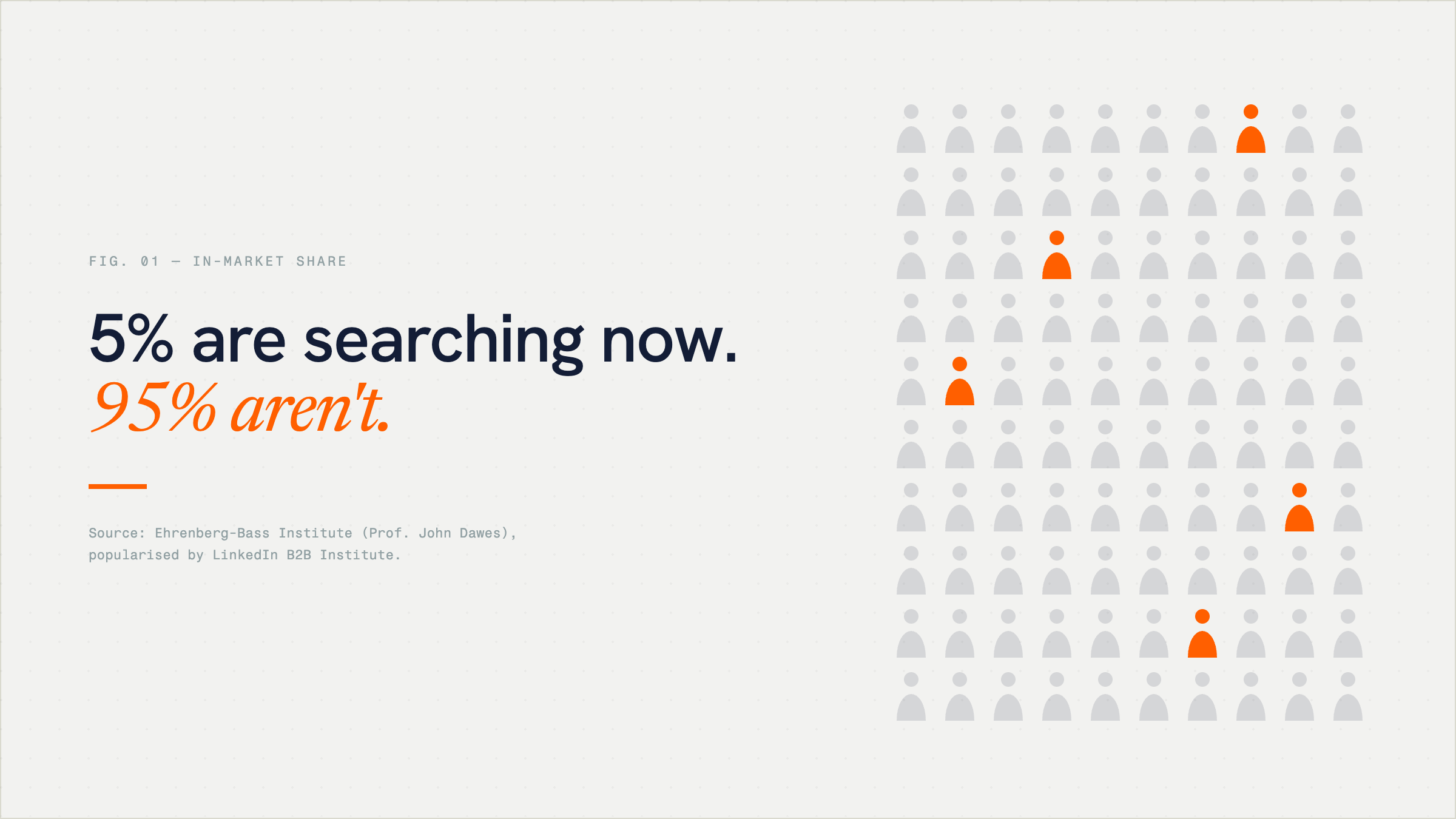
One: only a small slice of any B2B market is in-market at a given time. Research by Professor John Dawes at the Ehrenberg-Bass Institute, popularised in B2B through LinkedIn's B2B Institute, puts it at roughly 5%. The other 95% isn't ignoring your category out of disinterest, they simply aren't buying yet. Search and social platforms are built almost entirely to catch that 5%: someone types a query, or a feed algorithm infers intent from behaviour, and an ad appears. It's an efficient mechanism for a narrow slice of the market, and a structurally weak one for the other 95%, who generate no query and no obvious signal to target.
Two: the cost of reaching that 5% keeps rising, because everyone is fishing in the same small pond. Industry ad-benchmark reporting puts LinkedIn CPMs up roughly 28% year-over-year in recent periods, with some campaign-level data showing increases of 30–50% since 2023 on the most competitive B2B audiences. Search behaviour is shifting too: SparkToro's 2026 analysis of Similarweb clickstream data found that 68% of U.S. Google searches now end without a single click, up from roughly 60% two years earlier, and AI Overviews push that further: queries that trigger an Overview show an average zero-click rate of around 83%. Meanwhile Google's own AI Mode, powered by Gemini, is compounding query volume every quarter. Two effects are compounding at once: it's getting more expensive to reach the buyers who are in-market, and a growing share of the visibility you do win never sends anyone to your site at all.
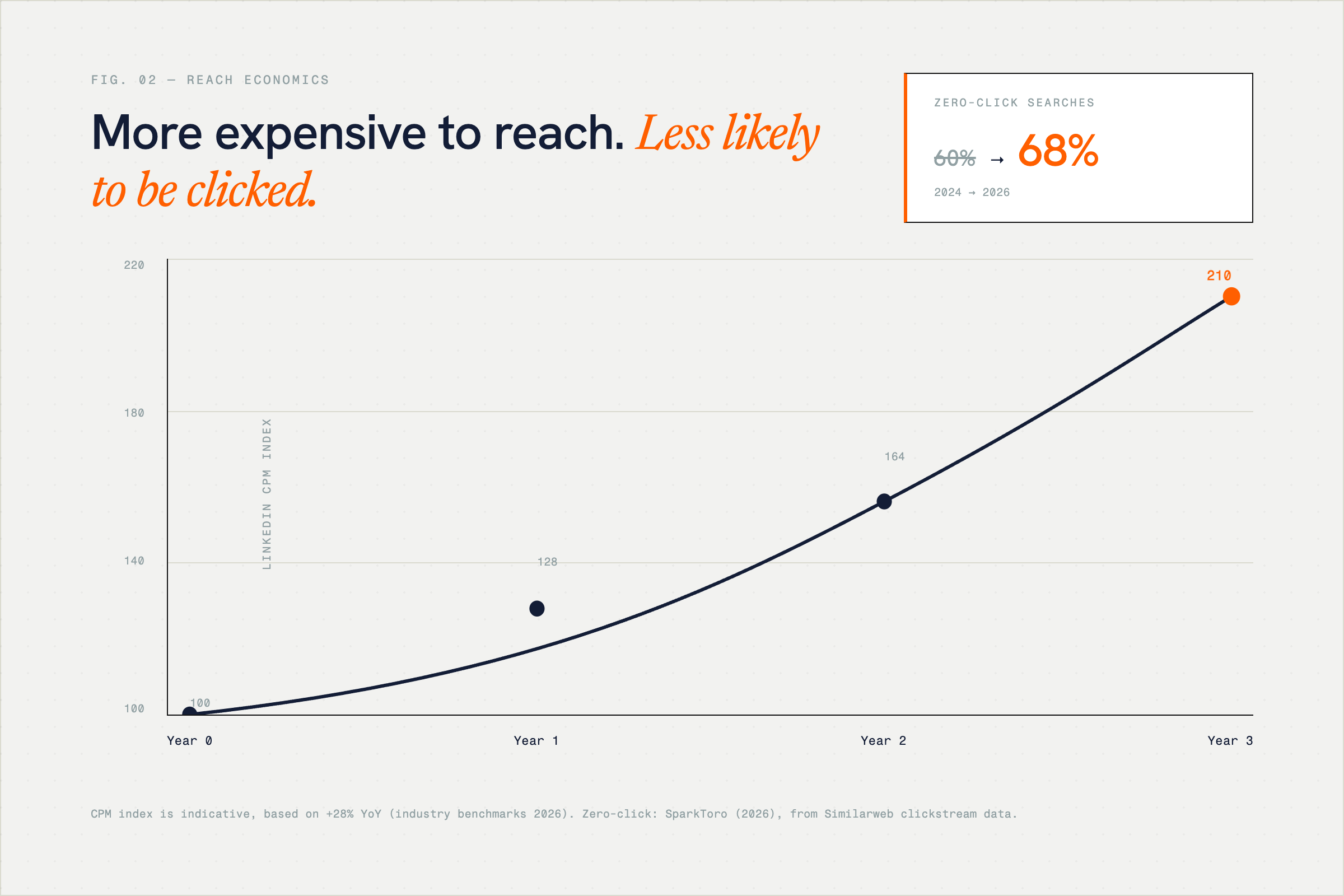
That's the ceiling. Not “Google and LinkedIn stopped working.” They're working precisely as designed, for precisely 5% of the market, at a price that keeps rising because that 5% is the only thing everyone is bidding on.
FACT AND FICTION
Is this just “more brand awareness”?
Before the framework, a few assumptions worth checking.
Assumption: “We just need to spend more on Google and LinkedIn.” More budget on the same two channels buys more competition for the same 5%, which is exactly why CPCs and CPMs keep climbing. It doesn't create new demand, it bids up the price of demand that already exists.
Assumption: “This is just brand awareness, and brand awareness isn't measurable.” Reach and share-of-voice in the 95% aren't measured by last-click attribution, but they're not unmeasurable. Branded search volume, share of answer in LLMs, and incrementality testing all quantify what happens before someone becomes a lead. It's a different measurement stack, not the absence of one.
Assumption: “Programmatic is remnant inventory and banner spam.” Not the version that matters here. Premium B2B programmatic runs private marketplace deals on named, vetted publishers, not open-exchange leftovers, and layers in B2B-specific intent data (account and buying-committee signals, not just cookies) to target the right accounts before they've typed anything into Google.
Assumption: “AI decides where the budget goes, so we lose control.” In a well-built Growth Media system, AI optimises bids, budget pacing, creative rotation and frequency capping inside boundaries you set. It does not decide who your audience is, what your message says, or which publishers meet your brand-safety bar. Those calls stay human, upfront.
Fact: this isn't an awareness-versus-performance argument. It's a coverage problem. Your current channels are built to win a fixed, shrinking 5% of the market at a rising price. Growth Media is how you show up for the other 95%, before they ever open Google or LinkedIn.
THE DEFINITION
What is Growth Media?
Growth Media is the deliberate use of paid channels beyond search and social, to reach B2B buyers before they enter an active buying process, measured with the same rigour as performance marketing. It sits alongside Strategy, Content, Performance and RevOps as the fifth pillar of a Gradient growth system: not a replacement for Google and LinkedIn, an extension into the part of the market those two channels structurally can't reach.
What makes it different from “just running more display ads” is precision and proof. Growth Media means named publishers, not vague “premium placements.” It means account-level and intent-based targeting, not broad demographic guesses. And it means every euro is tied to a measurement framework built for a channel that doesn't get a last click: unified marketing measurement, incrementality testing, and (where LLMs are the surface) citation tracking, rather than a vanity impression count.
THE FRAMEWORK
Seven channels, one media mix.
Reaching the 95% doesn't mean being everywhere. It means picking the channels that fit where your buyers actually spend attention, with named inventory and a clear price.
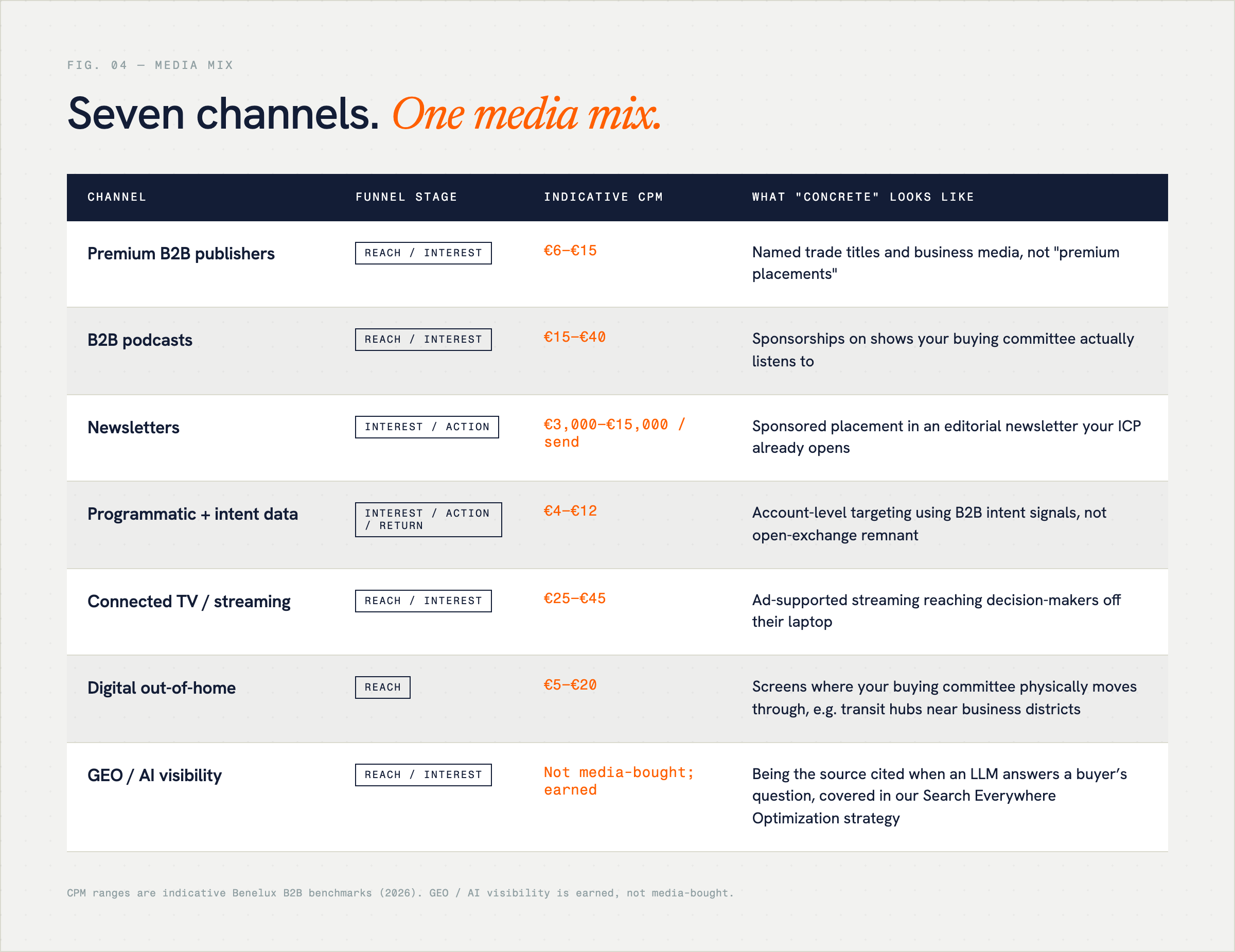
That last row matters: Growth Media and Search Everywhere Optimization overlap by design. A buyer who first sees your brand on a premium B2B publisher and later asks ChatGPT to compare vendors is served by both pillars working together, media builds the entity, search and GEO make sure that entity gets cited.
None of this is a reason to run all seven at once. It's a reason to pick the two or three that match your buying committee's actual media diet, and prove them before scaling.
WHERE TO START
Five steps before you spend a euro.
- Define the ICP and the goal precisely. “B2B decision-makers” isn't a targeting brief. Job titles, company size, industry, region, and the specific buying signal you're chasing (category entry, competitor displacement, expansion) are.
- Pick two channels, not seven. The table above is a menu, not a checklist. Choose the one or two channels where your buying committee's actual attention sits, and where you can prove incrementality within one full cycle.
- Set up measurement before the campaign goes live, not after. Unified marketing measurement and incrementality testing need a clean baseline. Bolting them on after launch means guessing at the counterfactual.
- Go live with enough weight to be seen. Underfunded Growth Media tests fail for the same reason underfunded TV tests fail: below a minimum frequency, you're not building an entity, you're wasting a budget line.
- Evaluate after one full cycle, not one week. Reach channels compound. A newsletter sponsorship or a premium-publisher placement that looks flat in week one can be the reason branded search lifts in month three.
THE PATTERN
Media ceilings show up differently in every growth motion.
Across the growth systems we've built, the same underlying constraint, media coverage capped at Google and LinkedIn, shows up as a different symptom depending on your go-to-market motion.
Founder-led growth and the founder's own LinkedIn network has been fully mined? Media ceiling in personal reach. Sales-led growth and outbound lists keep getting colder because paid search and LinkedIn can't produce enough net-new volume at a sane CPA? Media ceiling in top-of-funnel supply. Marketing-led growth and CPCs and CPMs climb while MQL volume flatlines? Media ceiling, plain and simple, you're bidding against everyone else for the same 5%. Marketing-led sales and MQLs plateau because every channel is recycling the same in-market audience? Media ceiling in net-new reach. Product-led growth and sign-ups stall despite a strong product, because too few people outside your existing audience ever hear about you? Media ceiling in top-of-funnel discovery. Product-led sales and expansion revenue is healthy but new-logo acquisition depends on the same two channels everyone else is bidding on? Media ceiling shared with every competitor in the auction. Partner-led sales and co-marketing reach never extends past your and your partner's existing followers? Media ceiling on both sides of the partnership.
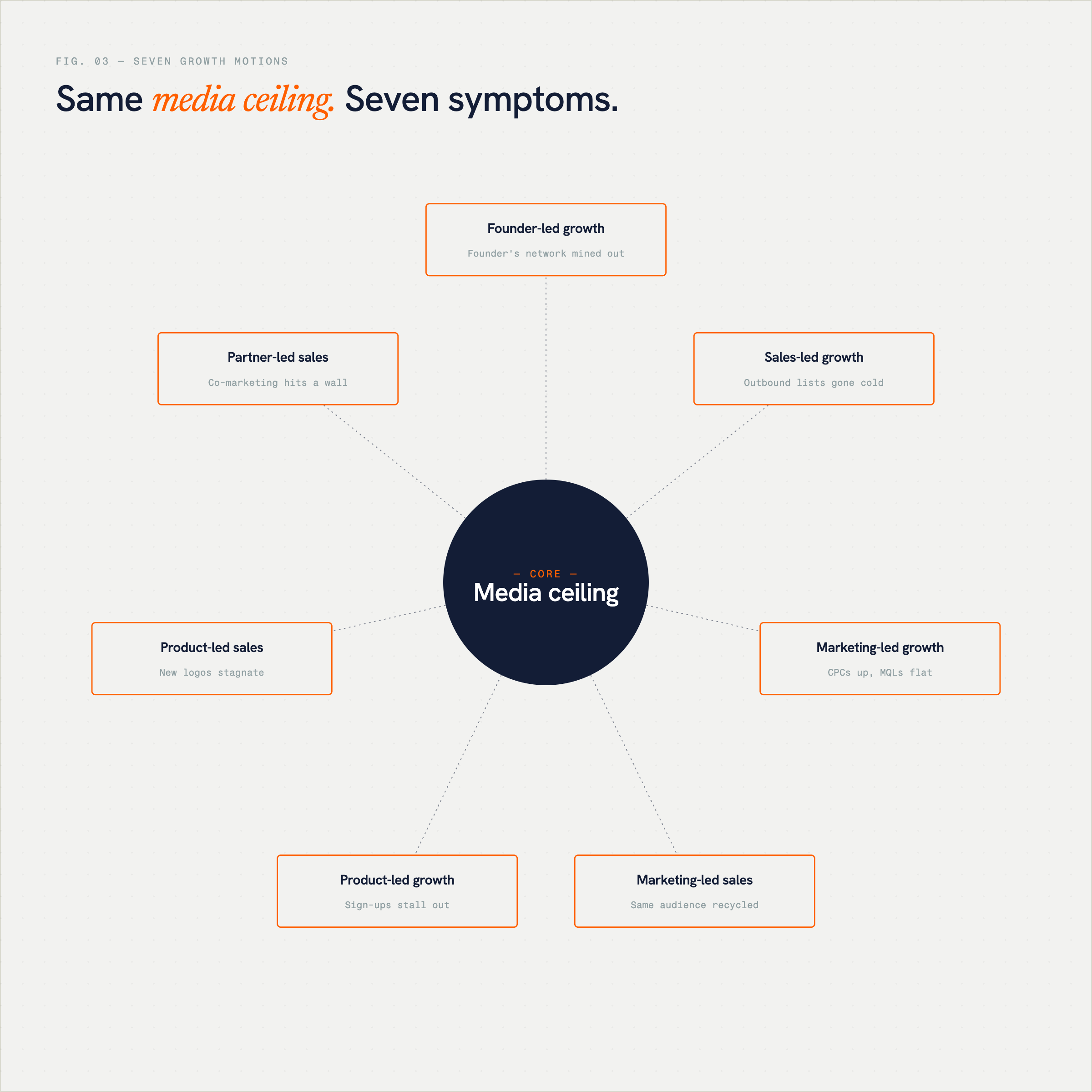
The conclusion is the same one that runs through every pillar of a growth system: whatever growth ceiling you're hitting, check whether it's actually a media-coverage problem before you assume it's a messaging, product or sales-process problem.
PROOF FROM PRACTICE
What we see across Gradient's growth systems.
Growth Media is the newest of Gradient's five pillars, built in partnership with media specialist DistrictNine, so we don't yet have a published Growth Media client result to point to the way we can for HubSpot adoption or Search Everywhere Optimization. What we can point to is the discipline it's built on: across more than 250 growth systems delivered for B2B clients, generating roughly €1.5B in B2B pipeline, the pattern has been consistent, growth stalls not because a channel is broken, but because the system around it stopped covering enough of the market. Growth Media applies that same architecture, and the same refusal to accept vague inventory or unproven placements, to the 95% that search and social structurally can't reach. As the first cohort of Growth Media engagements completes a full cycle, we'll publish the results here with the same rigour as everything else on this list.
WHAT TO DO
Five actions you can take this month.
- Audit where your buying committee's attention actually sits. Not where your media plan assumes it sits. Talk to five recent buyers about what they read, watch and listen to before they ever searched for you.
- Run the coverage math. Take your current Google and LinkedIn spend, and estimate what share of your total addressable market it can realistically reach, given that roughly 5% is in-market at any time. The gap is your Growth Media opportunity.
- Pick one reach channel and one proof metric before you brief a single publisher. Branded search lift, share of answer in LLMs, or an incrementality test, choose the metric before the media plan, not after.
- Name your inventory. If a media plan says “premium publishers” without naming the actual titles, send it back. Concrete is not optional.
- Build the seam between paid reach and organic findability. Whatever you buy attention for through Growth Media, make sure Search Everywhere Optimization is in place to convert that attention into a citation, a branded search, or a mention when a buyer later asks an LLM to compare vendors.
THE PRINCIPLE
It comes down to one principle.
You cannot performance-market your way to a market that isn't searching yet. Google and LinkedIn will keep getting more expensive for exactly the reason they're valuable, everyone is fishing in the same 5%. Growth doesn't come from bidding harder in that pond. It comes from building a system that reaches the other 95% before they arrive in it.
Or, in Gradient terms: your growth system isn't your ad account. Your growth system is how much of your actual market you're built to reach, in-market and out.
Frequently asked questions about Growth Media
What is Growth Media?
Growth Media is the deliberate use of paid channels beyond search and social, such as premium B2B publishers, podcasts, newsletters, programmatic and intent-based display, connected TV, DOOH and GEO/AI visibility, to reach B2B buyers before they enter an active buying process. It's measured with the same rigour as performance marketing: unified marketing measurement, incrementality testing and (for AI surfaces) citation tracking.
What is the 95-5 rule and why does it matter for media planning?
The 95-5 rule, based on research by Professor John Dawes at the Ehrenberg-Bass Institute and popularised by LinkedIn's B2B Institute, holds that at any given time only around 5% of a B2B category's potential buyers are actively in-market. The other 95% aren't searching or showing obvious buying signals, so search- and social-first channels structurally underserve them. It matters for media planning because it explains why budget concentrated only on Google and LinkedIn hits a ceiling: those channels are built to win the 5%, not the 95%.
Why are Google and LinkedIn getting more expensive for B2B advertisers?
Because demand for the same in-market 5% keeps rising while the size of that audience doesn't. Industry benchmark data shows LinkedIn CPMs up roughly 28% year-over-year in recent periods. On Google, a growing share of searches, roughly 68% as of 2026 per SparkToro's analysis of Similarweb clickstream data, end without a click at all, and that share is higher still on queries that trigger an AI Overview. More competition, less click-through, same audience size.
Is Growth Media just brand awareness spend?
No. Brand awareness spend historically meant broad reach with no clear measurement attached. Growth Media applies the same measurement discipline used in performance marketing, unified marketing measurement, incrementality testing, citation tracking, to reach channels. The goal is still deliberate: more of your addressable market recognising and eventually searching for your brand, provably, not just more impressions.
How do you measure a channel that doesn't produce a last click?
Three ways, used together. Unified marketing measurement connects media exposure to downstream branded search, direct traffic and pipeline, even without a click. Incrementality testing compares a market exposed to Growth Media against a holdout market to isolate the lift the media actually caused. And where the surface is an LLM rather than a search engine, citation tracking measures whether your brand gets named in the answer at all.
Which Growth Media channel should we start with?
Whichever one matches where your specific buying committee already spends attention, not the channel with the lowest CPM. Start with one or two, not all seven, set up measurement before launch, and evaluate after one full cycle rather than one week, reach channels compound slowly and rarely show results in the first seven days.
Sources: LinkedIn B2B Institute, The 95-5 Rule, citing research by Prof. John Dawes, Ehrenberg-Bass Institute · OpenAI, weekly active user disclosure (February 2026) · SparkToro, “In 2026, Less Than One Third of Google Searches Still Send a Click” (2026), based on Similarweb clickstream data · BrightEdge, AI Overview prevalence data (February 2026) · IAB, Podcast Ad Revenue Report (2026) · industry LinkedIn Ads benchmark reporting, 2026 (aggregated, recommend independent verification before citing externally) · internal Gradient × DistrictNine Growth Media channel and CPM data · internal Gradient observations.
Gradient is the B2B Growth Architecture firm that helps B2B companies design and build growth instead of leaving it to chance. We architect the commercial system where marketing, sales and service operate as one, including the media strategy that reaches buyers long before they ever open Google or LinkedIn.
This blog was written by the Gradient Growth Media Strategy Team.





Ready to design a more connected growth system?
Book a Call

Free Growth Scan

